
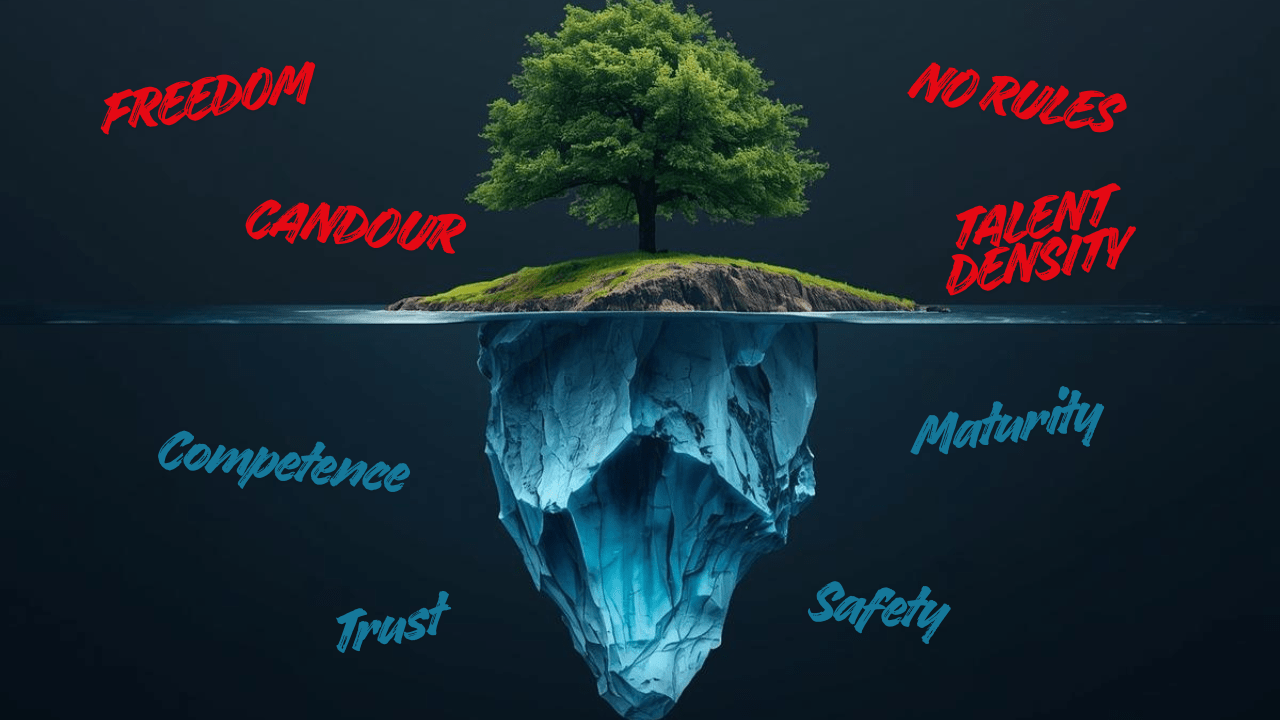
When I first read Netflix’s now-iconic culture deck, my reaction wasn’t admiration.
It was discomfort; a sharp, almost embarrassing discomfort.
Not because the ideas were radical.
But because they forced me to confront something I hadn’t questioned deeply enough:
Why do so many companies, including some I had worked in, behave as if people cannot be trusted?
Netflix’s philosophy flips almost everything we’ve been taught:
- Radical freedom
- Ruthless candour
- Minimal rules
- High talent density
- Leadership through context, not control
It’s seductive and intimidating at the same time.
But here’s the truth I learned — slowly, and sometimes painfully:
Netflix’s culture is not a set of “best practices.”
It is a maturity model.
And maturity cannot be copied.
It must be grown.
Culture Is an Evolutionary Ladder
Every organisation claims to want a high-performance culture.
But few pause to ask the uncomfortable, grounding question:
Where are we actually on the cultural maturity ladder?
People mature through stages: dependence → independence → interdependence.
Companies mature similarly: control → competence → trust.
Netflix operates at the top of that ladder.
Most organisations are still climbing somewhere in the middle.
Introducing high-autonomy values too early — before capability, context, skill and psychological safety exist — is like giving a teenager the keys to a high-performance car and hoping instinct will keep them safe.
It won’t!
Netflix’s culture assumes employees already have:
- emotional intelligence
- strong judgment
- deep domain competence
- peer-level trust
- accountability muscle memory
That isn’t normal.
It’s earned.
Culture is sequential, not aspirational.
You cannot skip steps.
Freedom Is Earned, Not Granted
When you look closely, Netflix’s most glamorous ideas — unlimited leave, no expense approvals, freedom in decision-making — are not perks.
They are outcomes.
Outcomes of a system where freedom is funded by responsibility.
- Freedom without accountability → drift
- Bureaucracy without trust → paralysis
- Freedom with accountability → mature performance
Most companies get the sequence wrong.
They adopt “freedom” too early; and end up drowning in chaos.
And this struck me personally, because for years I believed in the opposite philosophy:
Build systems that are people-independent and process-dependent.
Eliminate unpredictability.
Design for the lowest common denominator.
Netflix completely inverted that logic.
It made me uncomfortable, because it exposed something I hadn’t admitted:
Maybe I didn’t fully trust people enough.
Maybe I assumed they would default to carelessness.
Maybe I was designing for the weakest, not enabling the strongest.
Netflix designs for the highest maturity; and expects everyone to rise.
That’s not naïve.
It’s strategic.
A Moment From My Own Life That Shattered My Belief in Freedom First
Years back, during an MBA business simulation capstone project — a competitive market game with 15 teams — each team had full autonomy to run their company.
Freedom sounded great.
Except within my team, the first four rounds were a disaster.
Everyone was making decisions without logic or data.
Nobody took ownership.
We drifted down to the bottom of the rankings.
There was freedom.
But there was no maturity.
So I stepped in; analysing spreadsheets, studying market dynamics, piecing together a coherent strategy.
For four rounds straight, I became the operating backbone.
We went from last place to one of the top teams, winning multiple awards — Highest ROI, Rising From The Ashes, Market Maker.
That experience taught me a lesson that mirrors everything Netflix preaches:
Freedom without readiness is wasteful.
Freedom with readiness is transformative.
A system cannot give autonomy to people who aren’t yet capable of using it well. This is exactly why Netflix works; and why copying it blindly fails.
Talent Density: Excellence With a Pulse
One outstanding employee is worth three good employees.
It’s a beautiful idea; misused almost everywhere.
Talent density only works when the environment supports it:
- transparency
- trust
- clarity of expectations
- humane offboarding
- psychological safety
Without these, “talent density” becomes quiet fear disguised as excellence — where people perform out of anxiety, not inspiration.
The Keeper Test — “Would you fight to keep this person?” — is powerful
only when employees know the system is fair, not arbitrary.
Netflix’s talent density is not a hiring tactic.
It’s a cultural condition.
The maturity of the system protects the people inside it.
Candour: Powerful, Dangerous, Necessary
Candour is the value that looks easiest and causes the most damage when misapplied.
- Candour without empathy → cruelty
- Empathy without candour → stagnation
The art is in pairing the two.
And I learned this painfully, during my MBA.
In a hall of over 600 peers, I gave candid feedback to a recruitment coordinator; assuming honesty was expected and respected.
It wasn’t.
The reaction was instant! Pushback, criticism, even impact on my own recruitment process.
That day taught me something Netflix already integrates into its DNA:
Candour needs context.
Candour needs trust.
Candour needs psychological safety.
Without these, feedback becomes a weapon.
With them, feedback becomes acceleration.
Amy Edmondson’s work on psychological safety makes this clear:
Truth lands only when the foundation is stable.
Candour is not about speaking the truth.
It’s about ensuring the truth helps.
Maturity: The Hidden Variable Behind Every Cultural Success or Failure
Most failed cultural transformations have one root cause:
A maturity mismatch.
Companies adopt the values of a performing-stage organisation while still operating at a forming-stage reality.
Hersey-Blanchard’s Situational Leadership Theory shows that autonomy should scale with readiness.
Tuckman’s model (forming → storming → norming → performing) shows that self-management requires time, conflict resolution, and shared norms.
Give freedom too early → chaos.
Give candour without safety → harm.
Give flexibility without capability → inconsistency.
Netflix’s culture works because the people and the system are aligned in maturity.
This is the part no one can copy quickly.
Context, Not Control: Leadership’s Highest Challenge
Netflix’s leadership philosophy is simple, difficult, and powerful:
Give people context, not control.
Instead of prescribing the solution, leaders clarify:
- intent
- constraints
- information
- ownership
And then step back.
This is far harder than oversight.
Rules are easy.
Clarity is hard.
But clarity produces something priceless:
Speed without chaos.
The holy grail of high-performance organisations.
Context is the operating system of maturity.
From Copying to Cultivating
Most companies try to copy Netflix’s visible traits:
- No rules
- Radical candour
- Unlimited freedom
- High expectations
But these visible traits rest on invisible foundations:
- competence
- trust
- psychological safety
- readiness
- emotional maturity
- judgment
You cannot copy the fruit without growing the roots.
Culture is not a memo.
Culture is not a slide deck.
Culture is not a workshop.
Culture is behaviour under pressure.
Culture is what remains when nobody is watching.
Culture is maturity made visible.
What Netflix’s Culture Now Means to Me
When I revisit the Netflix culture deck today, I no longer see it as a template.
I see it as a mirror.
It forces uncomfortable, necessary questions:
- Where do we lack maturity?
- Where are we pretending to be “high performance” without the foundations?
- Which freedoms have we not earned yet?
- Where do we need more trust truly?
- And where do we need more capability before we earn that trust?
These questions matter far more than any cultural slogan.
Because freedom is easy to desire.
Candour is easy to preach.
Autonomy is easy to romanticise.
But maturity is what makes all of them work.
Final Reflection
Netflix is not a model to imitate.
It is a destination to grow toward.
A cultural pinnacle.
A point on the horizon that shows us what becomes possible
when competence, trust, psychological safety, and accountability
finally align.
So the real question isn’t:
How do we copy Netflix?
It is:
Are we mature enough for the freedoms we admire?
And even more honestly:
Am I mature enough in how I trust, challenge, and support the people around me?
Because at the end of the day:
- Freedom isn’t a perk.
- Candour isn’t a policy.
- Culture isn’t a document.
Culture is maturity in motion.
And maturity, individual or organisational, is always earned.
Further Reading And References
- Netflix Culture: Freedom & Responsibility
- Netflix Transparency on Firings
- Netflix Culture Abroad: Redefining American Culture Globally
- No Rules Rules: Netflix and the Culture of Invention
- Quartz Critique of the Keeper Test
- Amy Edmondson: Creating Psychological Safety in the Workplace (HBR Podcast)
- Amy Edmondson: Psychological Safety and Learning Behaviour in Work Teams (1999)
- Hersey-Blanchard Situational Leadership Theory (CFI)
- Bruce Tuckman’s Team Development Model (West Chester University)
- Herminia Ibarra, Anne Scoular: The Leader as Coach (Harvard Business Review)
- HBR: Organizational Culture Insights & Research
Share with your world

Discover more from Different Is Something
Subscribe to get the latest posts sent to your email.